
January 11, 2026: The Titan

Northbrook Symphony
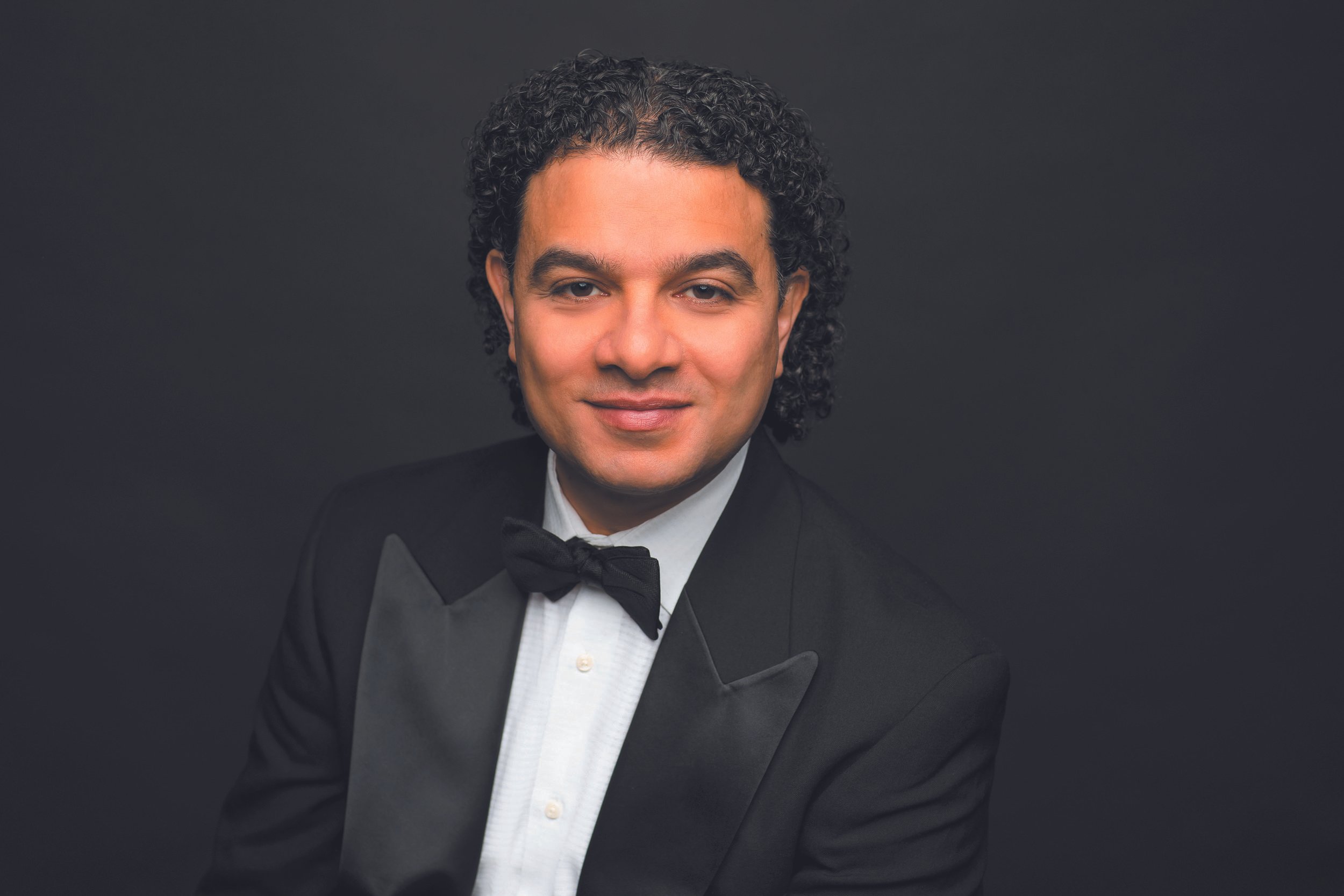
Mina Zikri, Music Director and conductor
Robbie Ellis, host, singer and arranger

This concert will be approximately 1 hour 45 minutes, including a 15-minute intermission.

Buy Tickets

Tom Lehrer (1928-2025) arr. Robbie Ellis (1984-)
The Wiener Schnitzel Waltz

Tom Lehrer arr. Robbie Ellis
Alma

Alma Mahler (1879-1964) arr. Robbie Ellis
Laue Sommernacht

Robbie Ellis after Johann Strauss I (1804-1849)
Radetetetetzky March

These four items are grouped as “A Taste of Vienna”. Tom Lehrer, who recently died at the age of 97, was most active as a piano satirist in the 1950s and 60s, though he made his career as a mathematics professor. He left behind a small but wickedly biting catalog of songs alluding to current events, politics, academia, and arts and culture; and a few years before his death he released all of his creative works into the public domain.

Two of his numbers fit nicely alongside Gustav Mahler’s Symphony No. 1. The Wiener Schnitzel Waltz is an absurd depiction of a glittering ball harking back to Mahler’s era in pre-war Vienna. Lehrer starts his song with the melody from Johann Strauss II’s The Blue Danube, though in my arrangement I’ve taken the liberty to add a few more Strauss waltz quotes. The next song, Alma, is a portrait of the strong-willed woman who became wife to Gustav Mahler and two other notable creatives, architect Walter Gropius and author Franz Werfel. Tom Lehrer also inserted plenty of quotes from Gustav Mahler’s works including Das Lied von der Erde, and I’ve inserted an additional verse that quotes Alma’s own songs.

Alma Schindler Mahler Gropius Werfel was a composer in her own right - a role that her husband Gustav discouraged for many years before a marital crisis forced him to relent and help her find a publisher. Many of her manuscripts are now lost, but among her published songs is Laue Sommernacht, a short and exquisitely slinky setting of Otto Julius Bierbaum’s poem about falling deeply in love on a balmy summer night.

“A Taste of Vienna” concludes with a nod to one of that city’s most well-known traditions: the playing of Johann Strauss I’s Radetzky March to finish the Vienna Philharmonic’s annual New Year’s Day concert, with the audience clapping along. I encourage you to clap along just the same, though I’ve mucked with Strauss’s original, stretching it into what I call the Radetetetetzky March.

Program notes by Robbie Ellis.

—Intermission (15 minutes)—

Gustav Mahler (1860-1911)
Symphony No. 1 in D major, “Titan”

I. Langsam, schleppend. Immer sehr gemächlich
II. Kräftig bewegt, doch nicht zu schnell
III. Feierlich und gemessen, ohne zu schleppen
IV. Stürmisch bewegt - Energisch

Mahler spent roughly 15 years perfecting his Symphony No. 1 from his very first ideas until the current version we are now familiar with. Considering its long gestation, this symphony can be viewed as something of a creative summary of Mahler’s early career as he was becoming the monumental artist we know him as today. This symphony, as with practically all of his works, draws from diverse inspirations with the goal of treating the composition as a universe unto itself.

We see Mahler re-imagining themes from his song cycle Lieder eines fahrenden Gesellen in the first and third movements, and we see evidence in earlier drafts of extra-musical programs drawn from both literary and visual sources. Mahler was inspired early on in his composing by the authors Jean Paul and E.T.A. Hoffmann, as well as the woodcut The Hunter’s Funeral Procession by Moritz von Schwind. The third movement, a funeral march, uses a minor-key version of the well known children’s song “Frère Jacques”, and the final movement was even subtitled “Dall’inferno al paradiso” after Dante Alighieri’s Divine Comedy.

Though he ultimately decided to remove direct references to these sources and programs in the final version, it is clear Mahler was thinking very much about depicting the natural world as well as a some sort of transcendent spiritual journey.

Program notes by Thomas Nickell.

Lyrics

The Wiener Schnitzel Waltz
Lyrics and music by Tom Lehrer (with a quote from Johann Strauss II)
Additional lyrics and arrangement by Robbie Ellis (with additional quotes from Johann Strauss II)

Do you remember the night I held you so tight
As we danced to the Wiener Schnitzel Waltz?
The music was gay and the setting was Viennese.
Your hair wore some roses (or perhaps they were peonies.)
I was blind to your obvious faults
As we danced cross the scene to the strains of the Wiener Schnitzel Waltz.

Oh I drank some champagne from your shoe, lalala,
I was drunk by the time I got through, lalala.
For I didn't know as I raised that cup
It had taken two bottles to fill the thing up.

It was I who stepped on your dress, lalala.
The skirts all came off, I confess, lalala.
Revealing for all of the ballroom to see
Just what it was that endeared you to me.

Oh I remember the night I held you so tight
As we danced to the Wiener Schnitzel Waltz.
Your skin looked quite pale and our symptoms were flu-like.
The music was cheesy and quite André Rieu-like.
We politely heard Austrian schmaltz,
And we both turned quite green to the strains of the Wiener Schnitzel Waltz.

Oh you couldn't resist my appeals, lalala.
You waltzed with me backwards in heels, lalala.
We ate sweet desserts and we felt out of sorts.
I caught salmonella from bad Sachertortes.

Then I spun you round like an LP, lalala,
Though much faster than 33, RPM.
Your stomach was roiled in a knot and a bunch,
Then you presented what you'd had for lunch.

Do you remember the night of medical plight
When we danced to the Wiener Schnitzel Waltz?
The music was saccharine and quite Johann Straussian.
That last instrumental was Die Fledermaussian.
Musicians from Europe played waltzes so heavenly
Like New Year's Day morning on WFMT.
You fainted, I waved smelling salts!
Plus I blew out my spleen as we danced to the Wiener Schnitzel Waltz!

Alma
Lyrics and music by Tom Lehrer (with quotes from Gustav Mahler)
Additional lyrics and arrangement by Robbie Ellis (with quotes from Alma Mahler)

The loveliest girl in Vienna
Was Alma, the smartest as well.
Once you picked her up on your antenna
You'd never be free of her spell.
Her lovers were many and varied
From the day she began her beguine.
There were three famous ones whom she married
And God knows how many between.

Alma, tell us:
All modern women are jealous.
Which of your magical wands
Got you Gustav and Walter and Franz?

The first one she married was Mahler,
Whose buddies all knew him as Gustav.
And each time he saw her he'd holler:
"Ach, that is the Fräulein I must have!"
Their marriage, however, was murdah.
He'd scream to the heavens above:
"I'm writing Das Lied von der Erde
Und she only wants to make love!"

Alma, tell us:
All modern women are jealous
You should have a statue in bronze
For bagging Gustav and Walter and Franz

While married to Gus she met Gropius
And soon she was swinging with Walter.
Gus died and her teardrops were copious;
She cried all the way to the altar.
But he would work late at the Bauhaus
And only came home now and then.
She said: "What am I running, a chow house?
It's time to change partners again!"

Alma, tell us:
All modern women are jealous!
Though you didn't even use Pond's
You got Gustav and Walter and Franz.

While married to Walt she met Werfel
And he too was caught in her net.
He married her but he was carefel
Cause she was no Saint Bernadette.
And that is the story of Alma
Who knew how to receive and to give.
The body that reached her embalmah
Was one that had known how to live!

Alma, tell us:
How can they help being jealous?
Ducks always envy the swans
Who get Gustav and Walter
You never did falter
With Gustav and Walter and...

I've so far sung words by Tom Lehrer,
A tribute that's witty and dry.
He didn't so much make an error
But didn't foresee DEI.
For Alma was quite the composer,
Which Gustav would poopoo and grouse.
This song shouldn't likewise bulldoze her;
A woman is more than her spouse!

Alma, sorry.
You were more than some men's quarry.
I'll quote your songs time and again...
Just as long as they're public domain.

Laue Sommernacht
Lyrics by Otto Julius Bierbaum
Music by Alma Mahler
Arrangement and translation by Robbie Ellis

Laue Sommernacht: am Himmel
Stand kein Stern, im weiten Walde
Suchten wir uns tief im Dunkel,
Und wir fanden uns.

Fanden uns im weiten Walde
In der Nacht, der sternenlosen,
Hielten staunend uns im Arme
In der dunklen Nacht.

War nicht unser ganzes Leben
Nur ein Tappen, nur ein Suchen?
Da: In seine Finsternisse
Liebe, fiel Dein Licht.

Balmy summer night
With no stars in the sky.
Deep in the woods we searched for each other in darkness
And we found ourselves.

Found ourselves in that wide forest
On that night bereft of starlight,
Stunned and dazed we held each other
In the dark of night.

Hadn’t we been all our lives long
Only grasping, only searching?
There into life’s gloomy darkness
Love! In fell your light.

Radetetetetzky March
Lyrics by Austrian Traditional
Music by Robbie Ellis after Johann Strauss I
Translation by Robbie Ellis

Klatsch Klatsch Klatsch usw.

Clap clap clap etc.

Mina Zikri
Music Director and Conductor

Mina Zikri was appointed Music Director of the Northbrook Symphony and assumed his artistic leadership duties in the 2019-20 season. As founder, music director, and conductor of the Oistrakh Symphony of Chicago, Zikri uses his considerable talents to forge relationships with artists and musical organizations throughout the world, all in the name of developing new audiences for classical music. As a violinist and assistant conductor to Daniel Barenboim, he travels with the West-Eastern Divan Orchestra on their annual tours to major music festivals and concert halls around the world. He returns each season to his native Egypt to guest-conduct the National Symphony.

At a time when even some of the greatest orchestras in the United States are falling under the pressures of financial and cultural uncertainty, Zikri believes that the future of symphony orchestras can, and must, venture beyond traditional expectations.

As a faculty member of the DePaul University Community Music Division, his career distinctions include being named one of 12 finalists in the 2007 Gustav Mahler International Conducting Competition, where he was chosen from 223 candidates from 40 countries. He was awarded a fellowship to the American Academy of Conducting in Aspen, Colo., where he studied with Hans Graf, Hugh Wolff, Christopher Seaman, Robert Spano and Larry Ratcliff. He holds a Bachelor’s, Master’s, and Performance Certificate in violin from DePaul University. 

Zikri has been the resident conductor for the Lira ensemble since 2011.  In 2018, Zikri made his conducting debut at Carnegie Hall with the Oistrakh Symphony of Chicago, with a return performance in June 2019.

Robbie Ellis
Host, Singer and Arranger

Robbie Ellis is the General Manager of the Northbrook Symphony. Prior to taking up the General Manager role, he worked for the NSO as their Pre-Concert Speaker and as a host, entertainer, composer and music arranger for fundraisers.

Robbie began his career in classical music radio at RNZ Concert in Wellington and Auckland, New Zealand. He hosts Sunday Afternoons with Robbie Ellis on WFMT Chicago, and for five years he was the host and producer of Introductions, a weekly feature of pre-college musicians. He is a regular pre-concert speaker with the Chicago Symphony Orchestra, the Grant Park Music Festival, Apollo's Fire, and the Rush Hour Concerts. He has also hosted events for Third Coast Percussion, Cedille Records, Chicago Jazz Philharmonic, and the Auckland Philharmonia.

A composer by training, he has performed as a musical comedian soloist with the Oistrakh Symphony of Chicago and the Chicago Metropolitan Symphony Orchestra. He has also had works performed by the New Zealand Symphony Orchestra, the Auckland Philharmonia, Orchestra Wellington, Auckland Youth Orchestra and more; and he has co-created comedy classical concerts with Fourth Coast Ensemble and the Lake Effect Clarinet Quartet. He held the 2012 Mozart Fellowship, a composer residency at the University of Otago in Dunedin, New Zealand.

Robbie has a long background as a music director for improv, sketch comedy, and musical theater. He regularly performs at the Chicago Magic Lounge as a music director; and has worked for all of Chicago's major comedy theaters including The Second City, iO, and The Annoyance. His music director work has also taken him into Chicago Public Schools as a teaching artist with Chicago Opera Theater.

He sings his own comedy songs from the piano and has released two albums, Pumpkins and Metric System. Robbie is a graduate of the University of Auckland School of Music and lives in Chicago with his wife, son, and cat.

www.robbieellis.net
@robbieellismusics

Marilyn Rea Beyer
Pre-Concert Speaker

Marilyn Rea Beyer first emceed concerts for her junior high school band in suburban Chicago. She listened to WFMT’s The Midnight Special as a teen. With degrees from Purdue and Northwestern, she worked in education, PR, and high tech. She launched her radio career in Boston in 1995. Returning to Chicago, Marilyn joined WFMT in 2020 hosting The Midnight Special and Folkstage and is in the Folk Alliance International DJ Hall of Fame.

Next
Next

October 5, 2025: Comfortably Classical