Susan Merdinger
Piano
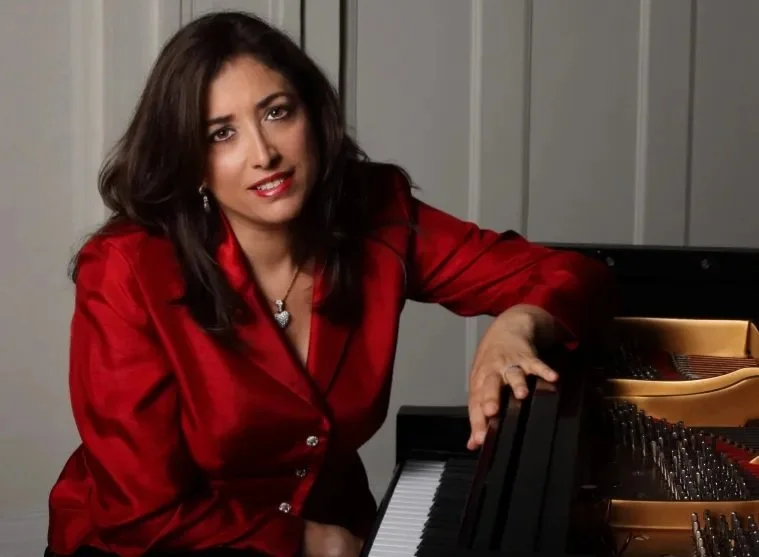
American Pianist Susan Merdinger is a dynamic and internationally acclaimed artist known for her expressive performances, innovative programming, and diverse musical voice. Hailed by the Frankfurter Allgemeine Zeitung for her “daring, enormously joyous presentation,” Merdinger’s artistry has been compared to legendary pianists such as Leonard Bernstein, Annie Fischer, and Nadia Reisenberg. Fanfare Magazine (2014) praised her “exquisitely detailed and full of life” recordings, particularly her celebrated Carnival album, featuring works of Robert Schumann.
A celebrated soloist, Merdinger made her debut at Carnegie Recital Hall at just 24, after winning the prestigious Artists International Young Musicians competition in New York. Since then, she has performed in some of the world’s leading venues, including Merkin Concert Hall, Sala Felipe Villanueva in Mexico, the Scottish National Orchestra Centre, Diligentia Hall, Chicago Symphony Center, the Art Institute of Chicago, and the Montreal Museum of Fine Arts. Her international debut recital tour, sponsored by the International Concert Administration, took her across Europe, earning her recognition as a performer of exceptional skill and artistry, while countless live performances have been featured on major broadcasts such as WQXR, WFMT, and BBC Television. Merdinger’s festival appearances include the Chautauqua, Norfolk, Fontainebleau, Summit and Burgos International Music Festival in Spain, where she has garnered acclaim for her performances in both solo recitals and chamber music concerts.
A passionate advocate for contemporary music, she has championed works by renowned composers like Morton Gould, Augusta Read Thomas, Ilya Levinson, Aaron Alter, and Margarita Zelenaia, whose works have been dedicated to her. In addition to her solo career, Merdinger enjoys an active role as a chamber musician, performing with internationally recognized artists and orchestra members of the Chicago Symphony Orchestra, the BBC Philharmonic, The National Symphony, New Jersey Symphony, and the New York Philharmonic. She has performed more than thirty piano concertos under the direction of esteemed conductors such as Gabriela Diaz Alatriste, Francesco Milioto, Mina Zikri, and Mattia Rondelli, with orchestras in the USA, Mexico and Europe. This marks Susan’s fourth appearance with the Northbrook Symphony.
Merdinger’s 2023-2024 season highlights included performances with her Sheridan Solisti Trio and the Highland Park Strings, as well as conducting the Northshore Chamber Orchestra in special concert programs. In 2025-2026, she will tour California and Florida with a new program, “All-American Piano Classics,” and performs Tchaikovsky’s Piano Concerto No. 1 with the Northbrook Symphony and records George Tantchev’s American Piano Concerto, dedicated to her. A noted recording artist, Merdinger has released over eleven albums, including American Melting Pot and French Fantasy, both of which have received rave reviews in publications like Fanfare Magazine and American Record Guide, and won two Gold Medals in the Global Music Awards. Winner of The American Prize’s Lorin Hollander Award for Piano Concerto Performance in 2020, her performances continue to captivate listeners with their passion and inimitable style.
A dedicated conductor, Merdinger brings an extraordinary breadth of experience to the podium, developed through decades of performing as a soloist, duo pianist, and chamber musician. Her conducting journey began under the tutelage of Robert Kapilow and Otto Werner Muellerat Yale. Known for her innovative programming and deep musical knowledge, Merdinger has guest-conducted various orchestras in the Chicago area, including conducting Mozart Concerti from the piano with the Highland Park Strings and her own Sheridan Sollisti Chamber Orchestra. Her vision for Sheridan Solisti reflects her lifelong commitment to promoting new music and mentoring gifted artists.
Merdinger is an alumna of Yale University, the Yale School of Music, the Manhattan School of Music, and the Ecole Normale de Musique in Fontainebleau, France. Her teachers included such “Steinway Immortals”- Claude Frank, Ozan Marsh, Constance Keene, and Gaby Casadesus, and Walter Hautzig. In addition to her performing career, Merdinger is an Artist Faculty member at the Summit Music Festival and the Burgos International Music Festival, and is the founder of Sheridan Music Studio, which encompasses a private music studio, record label, and live-streaming venue. A Steinway Artist since 2012, Merdinger was also awarded the Top Steinway Piano Teacher Award for 2024, continuing to captivate audiences and nurture the next generation of musicians while blending her unparalleled technical mastery with a profound emotional depth that sets her apart as a transformative artist and educator.