January 19, 2025: European Delights

Northbrook Symphony
Mina Zikri, Music Director
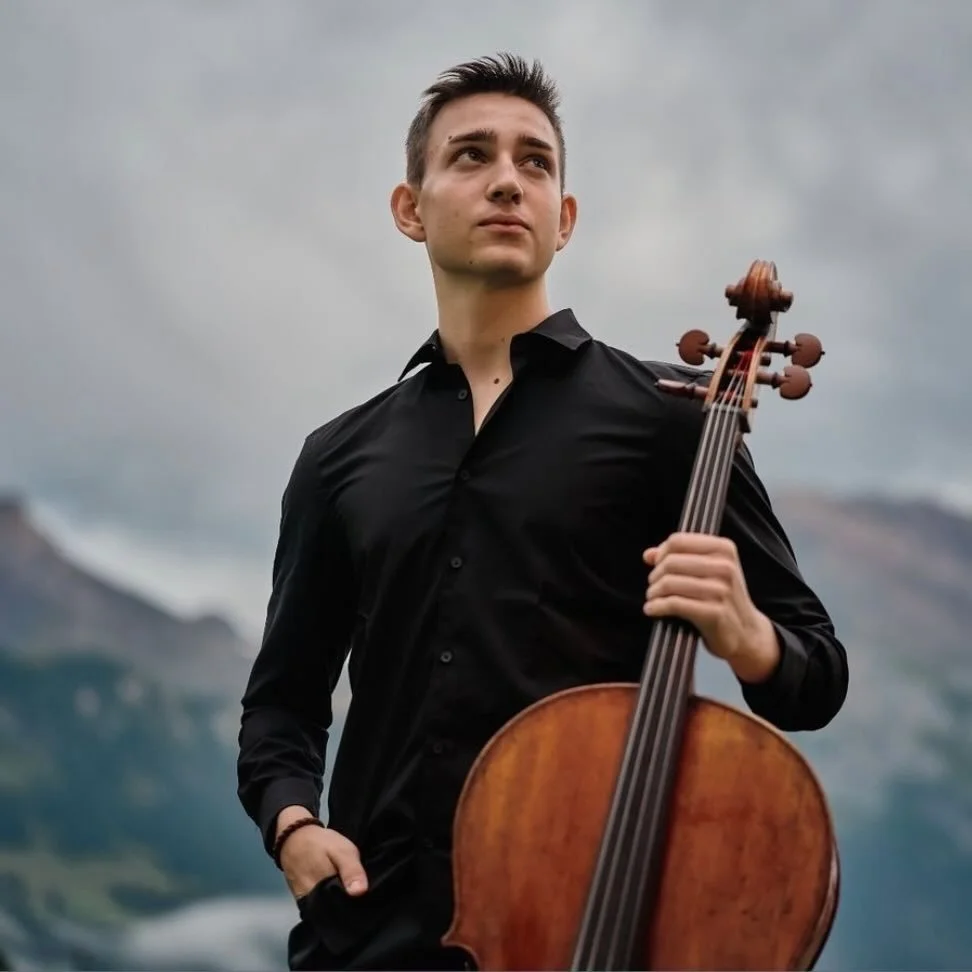
Jan Vargas Nedvetsky, cello

Antonín Dvořák (1841-1904)
Cello Concerto in B minor, Op. 104
I. Allegro
II. Adagio ma non troppo
III. Allegro moderato
Jan Vargas Nedvetsky, cello

Dvořák composed his only cello concerto from 1894-95. This was the final work composed during his 2 and a half years in America, where he was the director of the newly founded National Conservatory of Music. The Cello Concerto was also the last of only three concertos he composed in his life. Perhaps he spent his concerto writing energy well, as this work has become the most famous cello concerto in history, challenged only by Elgar’s Cello Concerto in E Minor. The inspiration for this work came after hearing Irish-American composer Victor Herbert’s Second Cello Concerto, of which Dvořák would become a great admirer. Chiefly, Dvořák was impressed by Herbert’s use of trombones and tuba, which he ended up adopting for his own concerto. The addition of extra brass instruments, which were typically absent from concertos to this point, posed problems for the solo cello in balancing both volume and register, as the trombones and tuba occupy the same low register as the cello. Dvořák’s solution was to create more opportunities for the cello to accompany the orchestra, rather than the other way around, allowing for greater musical dialogue. Another notable aspect of this concerto is the use of one of Dvořák’s Four Songs Op. 82, specifically “Leave Me Alone”, which he quotes at the climax of the second movement. This song was a favorite of Dvořák’s sister-in-law, who was his first love before he married her sister, and who became gravely ill while Dvořák was away in America. The finale returns to this theme, now in a major key, before the brilliant ending by the full orchestra.

—Intermission (15 minutes)—

Ludwig van Beethoven (1770-1827)
Leonore Overture No. 3, Op. 72b

Beethoven’s three Leonore Overtures were actually three separate attempts at composing the overture for his opera Fidelio, originally titled Leonore, about a woman who, disguised as a man, rescues her husband Florestan from imprisonment and death. All three Leonore Overtures, like the original title, were rejected in favor of the more succinct Fidelio Overture, on account of their being too complete in-and-of themselves. In fact, Beethoven spent more time working on his overtures than most composers spent on entire operas, which probably explains why he only completed one in his lifetime. This can however be seen as an example of Beethoven’s creative genius, as he was able to distill the drama of an entire opera into instrumental music lasting just under a quarter of an hour.

Johannes Brahms (1833-1897)
Variations on a Theme by Haydn, Op. 56b

Because Brahms created two versions of his Variations Op. 56 for orchestra and 2-pianos respectively, this composition is one of the few that has become a classic in two distinct genres. The reasons for that are not hard to discern after one has the opportunity to hear either version: the work is not especially long, the theme is pleasant and intriguing in that it comprises two 5-bar phrases rather than the usual 4 bars, and Brahms was able to display his compositional mastery, usually eschewed over large scale works, in just 8 variations and a finale, bringing to mind his transcendent late works for solo piano. Brahms composed these variations in the summer of 1873, the summer being a typically fruitful season for him, where he might retreat to the country later to emerge with a finished masterpiece. The theme of the variations, at the time attributed to Joseph Haydn, was later found not to be composed by Haydn at all, and to this day remains of unknown origins. Over the course of eight variations, perhaps better thought of as character pieces, Brahms breaks this simple theme into cells to be regrown as he sees fit, sometimes using just a few notes to build an entire variation. The Finale brings the work to a close with incredible virtuosity, employing all kinds of contrapuntal fireworks before a final fortissimo flourish.

Program notes by Thomas Nickell.


Jan Vargas Nedvetsky
Cello

Born in Chicago in 2006, cellist Jan Vargas Nedvetsky is recognized for “masterful and glorious musicianship” and “graceful atmospheric interpretations” (Pizzicato Liechtenstein Classical Reviews). Jan is a Fellow at the Academy of the Music Institute of Chicago, an advanced training center for gifted pre-college musicians, and a scholarship holder at the International Academy of Music in Liechtenstein where he takes part in the intensive music weeks and activities. In 2024 Jan has been named a YoungArts Winner with Distinction in Cello Performance, the highest honor of the National YoungArts Foundation, and has received a career grant from Young Arts Foundation.

In the past several seasons Jan has been invited to perform numerous recitals across the United States and Europe. Recent highlights include performances in Gstaad, Switzerland; Vaduz, Liechtenstein; Miami, Florida; Salmon, Idaho; Bend, Oregon; Cleveland, Ohio; Milwaukee, Wisconsin; St Paul, Minnesota; and Chicago, Illinois. Upcoming engagements include return solo recital on WFMT Chicago Classical Radio Introductions Program; appearance on the From the Top radio program; and recitals in Liechtenstein, Germany, and Chicago.

Jan studies cello performance with Prof. Hans Jorgen Jensen and Oleksa Mycyk at the Music Institute of Chicago Academy, and with Prof. Jens Peter Maintz at the Academy of Music in Liechtenstein. Previously Jan studied with Gilda Barston, Vladimir Perline, and Horacio Contreras, and received invaluable support from Ivan Karizna, Sihao He, Jihee Kim, and Sydney Lee. Jan performed in masterclasses with Jens Peter Maintz, Ivan Monighetti, Richard Aaron, Clive Greensmith, Jerome Pernoo, Lluis Claret, John Sharp, Richard Hirschl, Brandon Vamos, and Edward Arron.

As a solo and chamber performer Jan has won numerous awards in competitions and soloed with orchestras in the US and Europe. In 2023 Jan made a solo debut at the Chicago Symphony Orchestra Hall with Civic Orchestra of Chicago as a prize winner of the 2023 Chicago Symphony Orchestra Young Artist Competition. Additionally, Jan won First Prize in the 2023 Central Oregon Concerto Competition, 2023 Lakeview Orchestra Concerto Competition, 2022 Society of the American Musicians Competition, 2022 Chicago Chamber Orchestra Concerto Competition, and 2021 Chicago International Music Competition; received multiple awards in the Walgreens National Concerto Competition and DePaul National Concerto Festival, and was a finalist in the 2024 United States Marine Band Concerto Competition and 2024 Sphinx Competition.

With his chamber groups (string quartets and piano trios) Jan was a winner in 2021, 2022 and 2023 St Paul National String Quartet Competition, 2020 Chicago International Music Competition, 2019 and 2022 Barnett competition, and was a semi-finalist in four consecutive Fischoff National Chamber Music Competitions. He was coached in chamber music masterclasses by Menahem Pressler, Ivri Gitlis, Mathias Tacke, Sang Mee Lee, Paul Zafer, Cuarteto Latinoamericano, Leipzig, Talich and Prazak string quartets.

Jan participated in the 2016-2021 Musica Mundi International Chamber Music Festivals in Waterloo, Belgium, 2022, 2023 Meadowmount School of Music in Westport, NY, and 2024 Gstaad String Academy. He has been featured in the ABC and WTTW TV programs; WFMT Classical Radio, and TV Com Belgium.

Jan is a founding member of Musicians for Hope, an organization raising funds and creating opportunities for music education in Chicago-area public schools. Jan regularly performs in senior homes, public schools, and community events. Since age 9 Jan has performed in a Kol Nidrei service at the Congregation Sukkat Shalom in Wilmette.

Jan is a 12th grader at the North Atlantic Regional High School. In addition to performing and composing music, Jan pursues advanced studies in government and economics.

Previous
Previous

April 13, 2025: Two Titans

Next
Next

November 17, 2024: Chamber Delights